


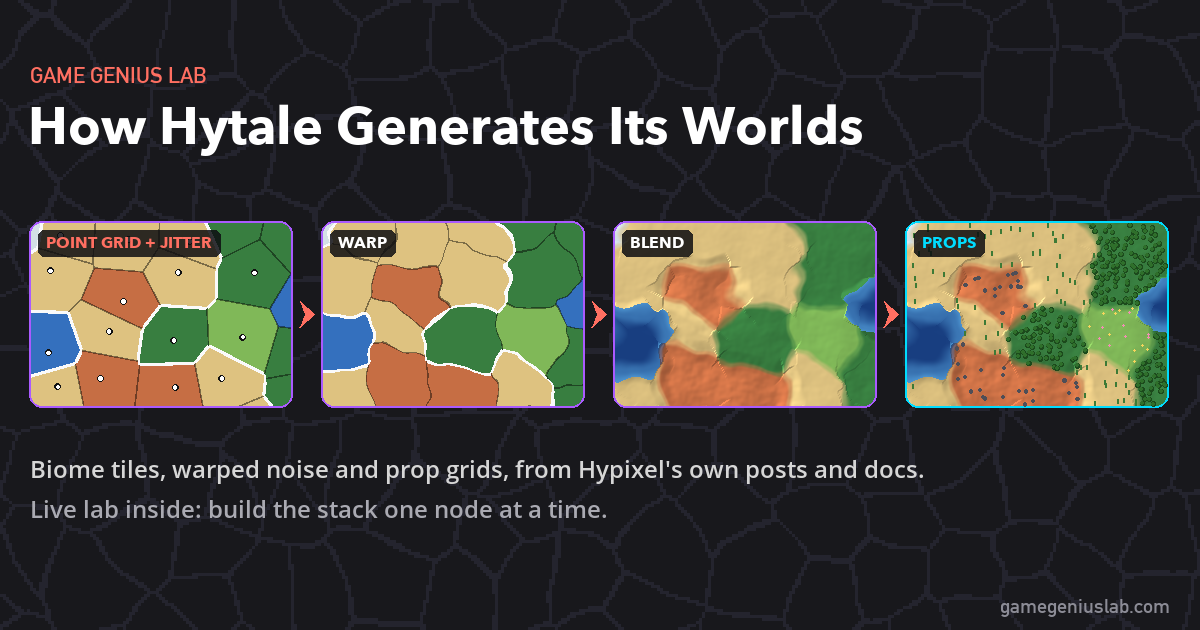
Hytale's next world generator treats every biome as a tile, blends the terrain across the seams and scatters props on a point grid. Here's what Hypixel has shared about World Gen V2, plus a live lab where you can build the same kind of stack.
Best Game Engines for Indie Developers (2026): How to Pick the Right One
Engine Finder
Which Engine Fits Your Game?
Six quick questions, 13 engines. The ranking updates as you click.
All 13 engines in this guide. Tap one to jump to its card.
The weights are our judgment, and each card below explains the reasoning. Your answers stay in your browser.
Choosing between the best game engines for indie developers comes down to three questions: is your game 2D or 3D, how much code do you want to write, and where will it ship? This guide compares 13 engines on exactly those points: what each one costs, the languages it uses, where it can export, and the weak spot its fans tend to skip. If you’d rather not read 13 cards, the Engine Finder above ranks them for your game in about 30 seconds.
What is a game engine? A game engine is the software that runs a game’s rendering, physics, input and audio, usually with an editor where you build levels and write scripts. A framework, like Phaser or LÖVE, gives you the same building blocks as a code library, without the editor.
How we chose: we looked at what indie games actually ship with on Steam, what our own readers click through to (Godot and Phaser lead), and what each engine costs once your game starts making money. Every version, price and license below was checked in October 2026.
The Short Answer
- Best for most indie developers: Godot. It’s free, open source, great at 2D and good at 3D.
- Best for 3D and mobile, with the biggest ecosystem: Unity.
- Best for high-end 3D: Unreal Engine 5.
- Best for 2D action and pixel-art games: GameMaker.
- Best for browser games: Phaser if you write code, Construct 3 or GDevelop if you don’t.
- Best for small, fast web and mobile builds: Defold.
- Best for visual novels: Ren’Py. Best for classic JRPGs: RPG Maker MZ.
- Best for programmers who want full control: LÖVE (Lua), MonoGame (C#) or Bevy (Rust).
The Best Game Engines for Indie Developers at a Glance
| Engine | Best at | Languages | Exports to | Cost for indies | Learning curve |
|---|---|---|---|---|---|
| Godot | 2D, stylized 3D | GDScript, C# | PC, mobile, web (GDScript only), consoles via porters | Free (MIT) | Gentle |
| Unity | 3D, mobile, 2D | C# | PC, mobile, web, consoles (Pro) | Free under $200K a year; Pro $2,310 per seat a year | Moderate |
| Unreal Engine 5 | High-end 3D | Blueprints, C++ | PC, mobile, consoles | Free up to $1M per game, then 5% | Steep |
| GameMaker | 2D | GML (code or visual) | PC, mobile, web, consoles (Enterprise) | Free for non-commercial use; $99.99 once to sell; $799.99 a year for consoles | Gentle |
| Defold | 2D, web and mobile | Lua | PC, mobile, web, consoles | Free | Moderate |
| Construct 3 | 2D, browser games | Events, JavaScript | Web, PC, mobile | From $129.99 a year | Gentle |
| GDevelop | 2D, simple 3D | Events, JavaScript | Web, PC, mobile | Free (MIT); paid plans for cloud builds | Gentlest |
| Phaser | 2D web games | JavaScript, TypeScript | Web | Free (MIT) | Moderate |
| LÖVE | 2D | Lua | PC, mobile | Free (zlib) | Moderate |
| MonoGame | 2D and 3D in code | C# | PC, mobile, consoles | Free (Ms-PL) | Steep |
| Bevy | Code-first 2D and 3D | Rust | PC, web | Free (MIT or Apache-2.0) | Steep |
| RPG Maker MZ | JRPGs | Events, JavaScript plugins | PC, web | $79.99 once | Gentle |
| Ren’Py | Visual novels | Ren’Py script, Python | PC, mobile, web (beta) | Free (MIT) | Gentle |
Console exports always need approval from Nintendo, Sony or Microsoft first. The Pick by Project section explains the console route for each engine.
What Indie Games Actually Ship With in 2026
Popularity isn’t everything, but it tells you how many tutorials, assets and answers you’ll find when you get stuck. Here’s what the 2026 data says, six ways. Tap a tab to switch data sets.
Engine Share, Six Ways
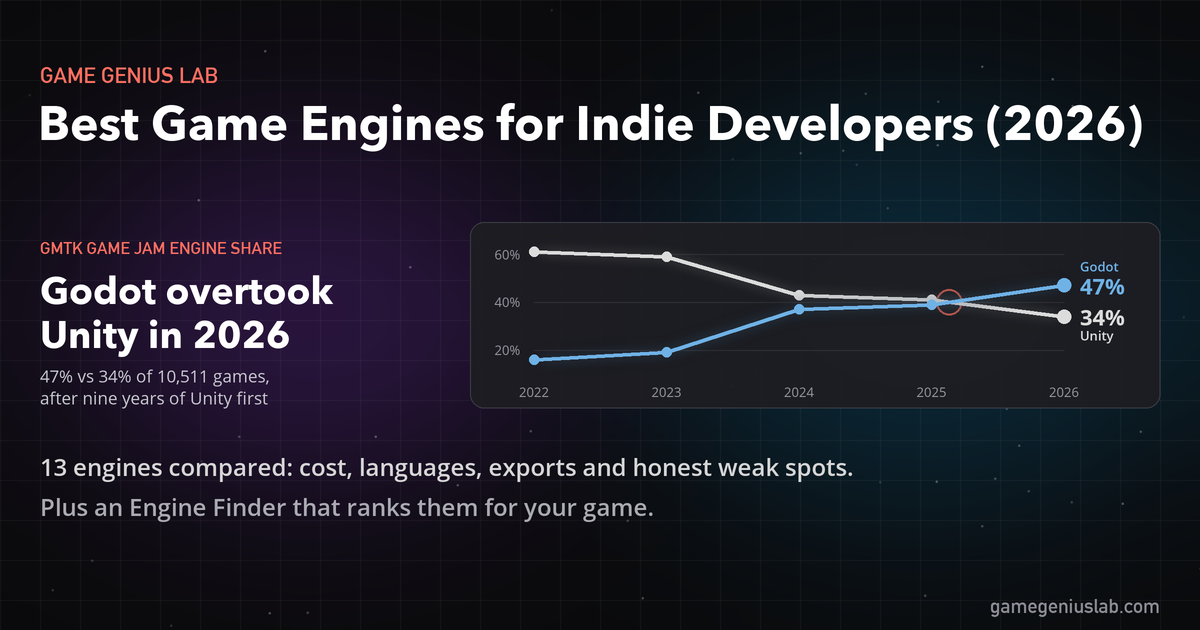
Put together: Unity is still the default, with about half of 2025’s Steam games. Unreal leads big-budget 3D, and its top hits earn the most. Godot is where new developers are heading: it overtook Unity at the GMTK Game Jam 2026 (47% to 34%) and grew from 9.2% to 12.6% of Next Fest demos between February and June. Godot’s share of commercial hits hasn’t caught up yet, but Slay the Spire 2 has shown that a Godot game can top the charts.
Sources: GameDiscoverCo on engine usage (March 2026), its February and June 2026 Next Fest reports, GMTK on 2026 and 2025, Automaton for 2022 to 2024, and GDC 2026 State of the Game Industry.
General-Purpose Game Engines
These three can make almost any kind of game. They have the biggest communities, so most tutorials, assets and job listings assume one of them.
Godot
2D games of any genre and stylized 3D
Free, open source (MIT) GDScript, C# Gentle learning curve
Godot is free, open source and quick to learn. Its node-and-scene system makes 2D games fast to build, its 3D is solid for stylized games, and you script in GDScript (which reads like Python) or C#. Version 4.7 (June 2026) added HDR output and area lights, and 4.8 is in beta. Mega Crit started Slay the Spire 2 in Unity, switched to Godot after Unity’s 2023 pricing change, and sold more than 3 million copies in its first week of early access.
Made with Godot: Slay the Spire 2 Brotato Buckshot Roulette Dome Keeper Cassette Beasts
Watch out for: there’s no built-in console export, so you’ll need a porter such as W4 Games (from $800 a year per platform for small studios). C# projects can’t export to the web yet. Realistic, high-end 3D still lags behind Unreal.
Unity
3D and mobile games, and the biggest library of tutorials and assets
Free under $200K a year; Pro $2,310 per seat a year C#, visual scripting Moderate learning curve
Unity is the most used engine on Steam, with about half of 2025’s releases. It’s strong at 2D and 3D, you script in C#, and it exports to everything from phones to Switch 2. Unity 6.6 is the latest release, 6.3 is the long-term support version, and Unity 7 is in alpha. The 2023 Runtime Fee was cancelled in September 2024. Today, Unity Personal is free until your revenue and funding pass $200,000 a year, and the “Made with Unity” splash screen is optional in Unity 6.
Made with Unity: Hollow Knight: Silksong Peak R.E.P.O. Schedule I Blue Prince
Watch out for: console builds need Pro. Unity is closed source, and its pricing has changed several times since 2023. With Unity 7 coming, long projects should expect some upgrade work.
Unreal Engine 5
Realistic and high-end 3D
Free up to $1M per game, then 5% Blueprints, C++ Steep learning curve
Unreal gives you high-end 3D out of the box: Nanite geometry, Lumen lighting and, since 5.8 (June 2026), a lighter Lumen Lite mode in beta. You can build whole games in Blueprints, its node-based visual scripting, and switch to C++ when you need speed. It’s free until a game earns $1 million. After that, Epic takes 5% of gross revenue, or 3.5% if you launch on the Epic Games Store at the same time as other stores, and sales on the Epic Games Store itself are excluded. Small teams do ship with it: Clair Obscur: Expedition 33 came from a core team of about 30, and Manor Lords mostly from one developer.
Watch out for: big installs, long builds and a strong PC. There’s no web export, and it’s overkill for most 2D games. Epic says 5.8 is the last planned Unreal Engine 5 release. Unreal Engine 6 (early access planned for late 2027) moves gameplay code to a new language, Verse.
2D Game Engines for Indie Developers
These engines are built around 2D first. Most of them are faster to learn than the big three, and two of them need no code at all.
GameMaker
2D action, platformers and pixel-art games
Free for non-commercial use; $99.99 once to sell GML Gentle learning curve
GameMaker has made 2D games since 1999. You script in GML, either as code or as drag-and-drop GML Visual, and rooms, sprites and collisions work the way 2D games expect. It’s free for non-commercial projects. Selling a game needs Professional ($99.99, one time), and consoles need Enterprise ($799.99 a year). No tier adds a splash screen or takes royalties. The current version is LTS 2026.0 (May 2026). A new runtime, GMRT, is in beta.
Made with GameMaker: Undertale Pizza Tower Katana Zero Loop Hero
Watch out for: 3D is basic. The classic runtime is frozen while GMRT is still in beta, so 2026 is a transition year. GML skills don’t carry over to other engines.
Construct 3
Beginners, prototypes and web games
From $129.99 a year event sheets, JavaScript Gentle learning curve
Construct 3 runs in your browser. You build logic in event sheets (“when the player touches a coin, add 1 to the score”) and add JavaScript or TypeScript when events aren’t enough. The October 2026 release added 3D lighting and model import, but it’s still a 2D tool at heart. Personal costs $15.99 a month or $129.99 a year. The free edition allows 50 events and exports to the web only.
Made with Construct: Mighty Goose
Watch out for: it’s subscription only, so if you stop paying you’re back to the free edition’s limits. There’s no native console export.
GDevelop
First games, game jams, web and mobile
Free (MIT); paid plans for cloud builds events, JavaScript Gentlest learning curve
GDevelop is free, open source and built around events instead of code, with JavaScript available when you need it. Version 5.6 added a real-time 3D editor. The free plan includes one desktop and one Android cloud build a day. Paid plans start at $7.99 a month and add more builds, iOS builds (from Gold) and the option to remove the GDevelop logo.
Watch out for: big projects get hard to organize as event lists grow. Games built on the free plan show the GDevelop logo, and companies earning over $50,000 a year need the Pro plan.
Defold
Web and mobile 2D games that need to stay small
Free, no royalties Lua Moderate learning curve
Defold is a free engine from the Defold Foundation with tiny, fast builds, which makes it a favorite for web and mobile games. You script in Lua. Console exports for Switch, PlayStation and, since version 1.14 (October 2026), Xbox are free once the platform holder approves you. Its license is source-available rather than open source: you can read and change the code, but you can’t sell the engine itself.
Watch out for: a smaller community and fewer tutorials than the big three. It can do 3D, but its tools are built around 2D.
Code-First Frameworks
Frameworks skip the editor. You get graphics, sound and input as a library and write everything else yourself. They suit programmers who like to know exactly what their game is doing.
Phaser
Web games, game jams and JavaScript developers
Free (MIT) JavaScript, TypeScript Moderate learning curve
Phaser is a free JavaScript framework for 2D browser games. You write JavaScript or TypeScript and test in any browser. Phaser 4 (April 2026) rebuilt the renderer, and 4.2.1 is the current version. Vampire Survivors started in Phaser before moving to Unity in 2023.
Watch out for: there’s no editor, so you’ll build your own tools or pair it with Tiled. Desktop and mobile releases need a wrapper such as Electron, and consoles aren’t realistic.
LÖVE
Programmers who like small tools and full control
Free (zlib) Lua Moderate learning curve
LÖVE is a small Lua framework for 2D games. It gives you a window, graphics, sound and input, and you write the rest. Balatro, which sold more than 5 million copies by January 2025, was made with it by a solo developer.
Watch out for: no editor, and no release since 11.5 in December 2023 (version 12.0 is in development). Consoles need porting work.
MonoGame
C# programmers who want control
Free (Ms-PL) C# Steep learning curve
MonoGame is the open-source successor to Microsoft’s XNA: a C# framework with no editor. Stardew Valley moved to it from XNA in 2021. Version 3.8.5 (July 2026) added DirectX 12 and Vulkan, and console builds are available to developers that the platform holders approve.
Made with MonoGame: Stardew Valley
Watch out for: you write your own editor and tools. Fewer games ship with it, so there are fewer recent tutorials.
Bevy
Rust programmers and simulation-heavy games
Free (MIT or Apache-2.0) Rust Steep learning curve
Bevy is a Rust engine built on ECS (entity component system): game objects are plain data, and systems run over them in parallel. It has no editor yet and every release brings breaking changes, but it moves fast: version 0.20 (October 2026) added path-traced lighting. Tiny Glade, made by a team of two, is built on a modified version of Bevy.
Watch out for: no editor, no 1.0 release, and an upgrade to do every few months.
Engines Built for One Genre
If your game fits their genre, these engines get you to a playable story faster than anything else.
RPG Maker MZ
Classic JRPGs and story RPGs
$79.99 once events, JavaScript plugins Gentle learning curve
RPG Maker MZ gives you maps, menus, turn-based battles and dialogue out of the box, so you can build a classic JRPG with events and no code. JavaScript plugins extend it. It costs $79.99 once and exports to Windows, macOS and the web. OMORI was made with the older RPG Maker MV, and a new version, RPG Maker U2U, has a Steam page but no release date yet.
Made with RPG Maker: OMORI
Watch out for: anything outside the JRPG template means plugin work. Mobile builds mean wrapping the web version yourself, and consoles need a porting company.
Ren’Py
Visual novels and dialogue-heavy games
Free (MIT, with some LGPL parts) Ren’Py script, Python Gentle learning curve
Ren’Py is the standard engine for visual novels. You write scenes like a screenplay, with Python available for game logic. It’s free and exports to Windows, macOS and Linux, with Android, iOS and a beta web export through add-ons. The latest version is 8.5.3 (May 2026).
Made with Ren’Py: Doki Doki Literature Club! Slay the Princess
Watch out for: it’s built for one genre, and anything else fights the engine. There’s no official console support.
Also Worth a Look
- Stride: a free C# engine with a full 3D editor (Windows only). Version 4.4 shipped in October 2026.
- Flax Engine: a C# and C++ 3D engine with visual scripting. Royalties of 4% start once a game earns more than $250,000 in a quarter.
- Cocos Creator: a TypeScript engine popular for mobile and mini-games. COCOS 4 is in alpha as a fully open-source (MIT) release.
- O3DE: a heavyweight open-source 3D engine run by the Linux Foundation, for teams with strong PCs and patience.
- raylib: a tiny C library for programmers who want to learn how games work from the ground up.
- PICO-8: a $14.99 “fantasy console” with a 128×128 screen, 16 colors and Lua. Its limits are the point: it’s a great way to learn to finish small games.
For the full list of free engines, art apps and audio tools, see our open source game development tools guide.
Pick by Project
Your First Game
Pick the engine that gets you to “playable” fastest. If you don’t want to code, start with GDevelop (free) or Construct 3. If you want to learn programming as you go, Godot and GameMaker both use scripting languages that are easy to read. Keep the first project tiny: one mechanic, one level, finished in a month.
A 2D Platformer, Metroidvania or Action Game
GameMaker or Godot. GameMaker has the longer track record (Undertale, Pizza Tower, Katana Zero), and Godot is free and open source with an excellent 2D toolset. Unity is a fine 2D choice too: Hollow Knight: Silksong was built with it.
A 3D Game
For stylized or small-scale 3D, Godot or Unity. For realistic graphics, open worlds or anything that depends on lighting, Unreal. If you’re new to 3D, plan a smaller game than you think you need.
A Browser Game or Game Jam Entry
Phaser if you know JavaScript. Construct 3 or GDevelop if you don’t want to code. Defold if you want small, fast builds. Godot exports to the web as long as you use GDScript. Unreal can’t export to the web at all.
A Mobile Game
Unity has the deepest mobile tooling, including ads and in-app purchases. Defold and Godot are strong free options, and Defold’s builds stay especially small.
A Console Release
Every route starts with approval from Nintendo, Sony or Microsoft. After that, Unreal and MonoGame cost nothing extra. Unity needs Pro, and GameMaker needs Enterprise. Defold’s console exports are free for approved developers. Godot goes through a porter such as W4 Games. Construct, GDevelop, Phaser, LÖVE, RPG Maker and Ren’Py games usually need a porting company.
A Visual Novel or JRPG
Ren’Py for visual novels, RPG Maker MZ for classic JRPGs. Both get you to a playable story in days, not months.
A Simulation, Roguelike or Strategy Game Built in Code
Systems-heavy games are mostly code, so frameworks shine here: LÖVE, MonoGame, or Bevy, whose ECS handles thousands of entities well. Godot and Unity work too. If your game generates its own worlds, our tutorials on Perlin noise, Voronoi diagrams and cellular automata work in any engine on this list.
Does Your Engine Choice Matter That Much?
Less than the internet suggests. Balatro was made with a framework that has no editor and hasn’t had a release since 2023. Stardew Valley launched on XNA, a framework Microsoft had already stopped developing, and moved to MonoGame years later. Mega Crit changed engines in the middle of making Slay the Spire 2 and still had a hit.
What matters more is whether you can finish a game in it, whether the license fits your plans, and whether the engine’s weak spot hits your project. A 2D pixel-art game in Unreal or a realistic open world in GameMaker will fight you every day. Most other choices come down to taste.
Switching engines in the middle of a project costs months. Before you commit, spend a week prototyping the riskiest part of your game (online multiplayer, thousands of units, a console build) in the engine you’re leaning toward.
FAQ
What Is the Best Game Engine for Beginners?
GDevelop and Construct 3 if you want to avoid code, and Godot or GameMaker if you want to learn programming as you go. All four have free versions, so try two of them for a weekend each and keep the one that feels natural.
Is Godot Good Enough for Commercial Games?
Yes. Brotato, Dome Keeper, Buckshot Roulette and Slay the Spire 2 are all commercial Godot games, and the MIT license means no fees or royalties. The two gaps are console exports, which go through a porter, and top-end 3D.
Do I Have to Pay Royalties to Unity or Unreal?
Unity charges no royalties, since the Runtime Fee was cancelled in 2024. You pay for Pro seats once your revenue and funding pass $200,000 a year. Unreal takes 5% of gross revenue above $1 million per game, or 3.5% under Epic’s “Launch Everywhere with Epic” program, and nothing on Epic Games Store sales. Godot, GameMaker and Defold charge no royalties.
Which Engine Do Most Indie Games on Steam Use?
Unity, by a wide margin: about half of the games released on Steam in 2025. Unreal is second with about a fifth, and Godot is third with about 7% and rising fastest.
Can I Make a Game Without Coding?
Yes. GDevelop, Construct 3 and RPG Maker MZ use events instead of code, and Unreal’s Blueprints are a full visual scripting system. You’ll still think like a programmer, with conditions, variables and loops, but you won’t type code.
Should I Build My Own Engine?
Only if building the engine is part of the fun, or your game needs something no engine does well. For a first commercial game, an existing engine will get you to launch faster. Frameworks like LÖVE, MonoGame and raylib are a good middle ground: you write your own game loop but skip the platform code.
Final Thoughts
No engine wins every category in 2026. Godot is the best default for most indie developers, Unity still has the biggest ecosystem, and Unreal owns high-end 3D. The specialists, from GameMaker to Ren’Py, win when your project matches what they were built for.
Pick one, prototype for a week, and switch only if its weak spot is a deal-breaker for your game. The best engine is the one you finish a game in.
Next steps:
- Need free art, audio and level tools to go with your engine? See our guide to open source game development tools.
- Want the full kit, free and paid? Read The Indie Game Developer’s Toolkit.
- Ready to build something? Our biome generation tutorial works in any engine on this list.
- Coming next on the blog: what October’s Steam Next Fest says about engines and genres.
Which engine are you using, and what made you pick it? Tell us in the comments.
Related Posts
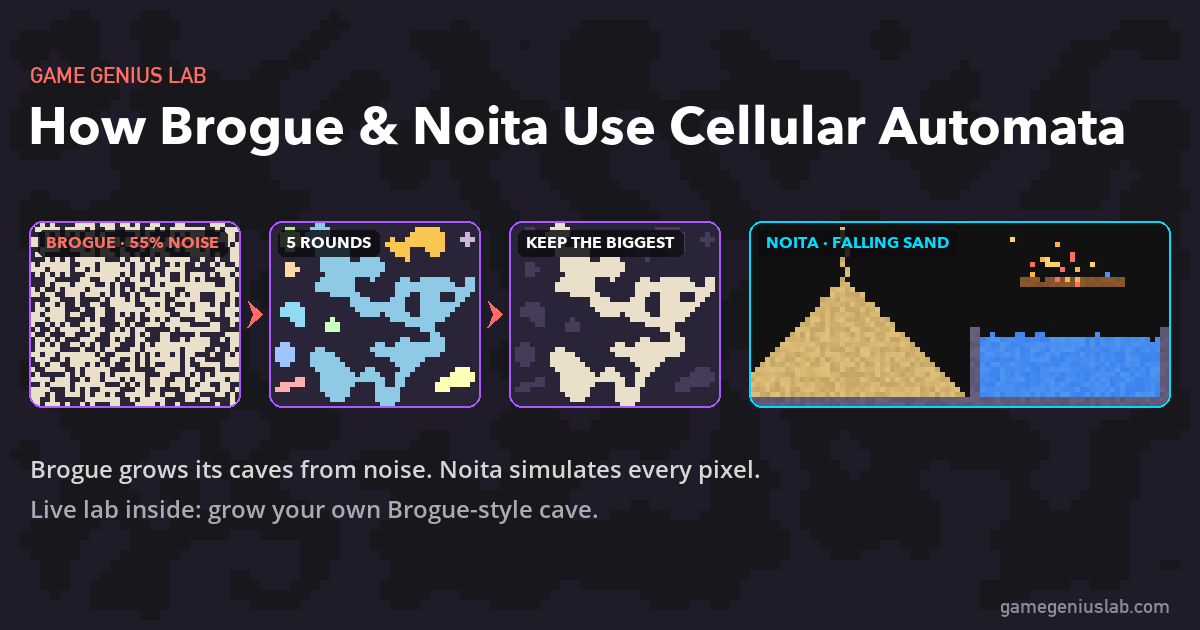
Brogue grows its caves from 55% random noise and five rounds of a cellular automaton. Noita simulates its world pixel by pixel, bottom-up, in 64×64 chunks. See how both work, then grow a Brogue-style cave blob in a live lab.
How a small browser synth for game sound effects evolved into Arcade Composer, a full music workstation built for fast, game-focused audio workflow.
This Post Has 0 Comments