



Jump, coin, hit, laser and explosion: five classic retro sound effects, built step by step in Pulse, our free browser sound effect generator. Play each one before and after in the Retro SFX Lab, learn why it works, and take the settings with you.
Steam’s AI Disclosure Rules for Audio, Art & Code (2026): What You Actually Have to Declare
Steam AI disclosure comes down to one question on Valve’s form: did generative AI make anything players see, hear or read, in the game, on the store page or in your marketing? Since Valve rewrote the form in January 2026, AI tools that only make you faster, code assistants included, are explicitly not what it’s asking about. Art, music, sound effects, voice, writing and translation are.
This guide walks through the form field by field, sorts each kind of asset into Valve’s categories, covers the license question that comes before any AI music or voice reaches your build, and ends with disclosure wording you can adapt. The checker further down does the sorting for your own game and drafts the message players will see.
This is a guide, not legal advice. It quotes Valve’s Steamworks documentation and the AI tools’ terms as I read them on November 24, 2026. Valve has already changed this form once in 2026, and Suno’s and Udio’s terms have both changed since late 2025, so check the live pages before you submit. If a lot of money rides on a track or a voice, ask a lawyer.
What Changed in January 2026
The question used to be whether you used AI. Now it’s whether players consume what AI made.
Valve added AI questions to Steam’s Content Survey in January 2024, when it announced it would release “the vast majority of games” that use AI. Before the rewrite, the form opened by saying its focus was generative AI while the game is running, then asked two things: did you use AI to generate pre-rendered content for the game, its store page, marketing or community assets, and does it live-generate content or code during gameplay.
On January 16, 2026, Simon Carless of GameDiscoverCo spotted a rewritten version and posted before-and-after screenshots. I found no announcement from Valve, but the public Content Survey documentation now uses the same wording. Three things changed:
- Efficiency tools are out of scope, in writing. The section now opens by acknowledging that many development environments have AI built in, and says “efficiency gains through the use of these tools is not the focus of this section.”
- The test is what players consume. The section is concerned with AI used “in creating content that ships with your game, and is consumed by players”, and Valve’s examples are artwork, sound, narrative and localization.
- One gateway question, then two parts. A yes or no on whether the game uses generative AI to make content at all, a message for your store page, and a separate yes or no for content generated during gameplay.
The store page and marketing are still in scope, live generation still needs guardrails, and Valve still reviews AI output like any other content in your build.
The Form, Field by Field
Two yes-or-no questions and one message to players. The message is the part people actually read.
The questions sit in your app’s Content Survey in Steamworks, in the section headed Generative Artificial Intelligence (AI). Wording below is from the January 2026 form and Valve’s documentation page:
| Field | What it asks | What happens with your answer |
|---|---|---|
| The gateway question | Does the game use generative AI to generate content, pre-rendered or live-generated? It covers “the game itself, the store page, and any Steam community assets or marketing materials.” | Yes opens the rest of the section. |
| Store Page Description | A message to players describing how the game uses generative AI. | Steam shows it on your store page under About This Game, headed “AI Generated Content Disclosure”. You can edit it and its translations at any time. |
| Content Generated During Gameplay | Does the game use AI to generate content or code during gameplay? | Yes means describing the guardrails that keep illegal content away from players. |
Valve’s Two Categories
Valve’s documentation sorts AI content into Pre-Generated and Live-Generated:
- Pre-Generated: content that ships with the game and is consumed by players, “created with the help of AI tools during development.” Valve reviews it the same way as everything else, against what you promised in the Steam Distribution Agreement: nothing illegal or infringing, and a game consistent with its marketing.
- Live-Generated: content AI creates while the game runs. Same rules, plus the guardrails description. The form says Steam gives players a Steam Overlay tool to flag inappropriate or infringing output, and that failing to stop illegal content gets the app pulled. Valve doesn’t ship Live-Generated AI in Adult Only Sexual Content games at all.
Two lines in Valve’s FAQ matter later on. Products have to follow Steam’s content rules “regardless of whether it is disclosed”, so a disclosure never makes anything acceptable. And once your build and store page are approved, some survey answers can only be changed by contacting Steam Support with a summary of what changed. The message to players stays editable.
Do I Need to Disclose This? Check Your Game
Tick everything AI touched. The checker maps each tick to the form and drafts your Store Page Description. The next two sections explain every row, including AI built into tools like Blender and your DAW.
Tick a row if a generative AI produced any part of it that players see, hear or read, even if you reworked it afterwards. AI that only ran steps you chose, showed you how, or cleaned up your own work goes under Code or tool help. Each tick shows which part of Steam's form it falls under, and the box at the bottom drafts the message players will see.
Your answers on Steam's form
- Does this game use generative AI to generate content for the game, including its store page, community assets and marketing?
- No
- Does this game use AI to generate content or code during gameplay?
- No
- Store Page Description (the message players see)
- Leave empty
Where each tick lands
- Nothing ticked yet. If no AI-made content reaches players, the answer to both questions is No.
You've edited the draft, so new ticks won't overwrite it. Rebuild draft starts over from your ticks.
Not legal advice. This maps your answers to the wording of Valve's Content Survey page and the Steamworks AI form as of November 24, 2026. Valve reviews your game, not this checker, and the rules can change. Check the current form before you submit.
What’s Exempt: Code Assistants and Dev-Side Tools
If AI only made you faster and players never consume its output, the form isn’t asking about it. The line is drawn at the output, not the tool.
- Code from an assistant. Copilot, Cursor, Claude Code and your engine’s built-in AI helpers write code that ships in your binary, but code isn’t on Valve’s list of content players consume. That’s exactly what the efficiency line in the form covers. The exception is a game that generates code while it runs, because the gameplay question asks about “content or code”.
- Work that never reaches players. Design docs, task lists, bug triage, market research, rubber-ducking a shader.
- Placeholders, until they ship. A temp voice line or a generated test texture is outside the form only while it stays out of the build players install. Clair Obscur, in the cautionary tales below, shows what happens when one slips through.
Players see code differently. In GameDiscoverCo’s July 2026 survey of about 3,800 core Steam fans, 56% said AI coding help should be disclosed, and only 8% said it shouldn’t. Steam doesn’t require it, so volunteering it is a marketing decision, not a compliance one.
The Grey Zone: AI Concept Art
Valve’s definition covers shipped content “created with the help of AI tools,” and it doesn’t say where help ends. An AI image you painted over, traced or used as a base is help, so disclose the asset. ArcheAge Chronicles does exactly that on its store page: it says AI tools were “used only as a starting point” for some visual assets and lists which ones.
The case Valve leaves open is an AI image used as one mood reference among many, with the final asset drawn from scratch. The wording doesn’t settle it either way, so the safe call is one sentence in your disclosure. It costs far less than players finding out later.
AI Inside Blender, Your DAW and Photoshop
Most creative tools now have an AI assistant built in, so the same app can land on either side of Valve’s line. Ask what the AI produced. If it decided what something looks, sounds or reads like, and that survives into the build, it’s Pre-Generated content, however much you reworked it afterwards. If it ran steps you had already decided on, showed you how to do something, or only processed work you made, that’s the efficiency gain the form says it isn’t asking about.
Valve doesn’t spell this out, so treat it as my reading. Two marketplaces draw the same line in writing. Fab’s license counts content as made with generative AI when “a material portion” of it was generated, and excludes features that “solely operate on the Content”, naming content-aware fill and AI upscaling. itch.io asks you to tag any project that contains “materials produced by generative AI”. Steam’s wording has no materiality threshold, so a small use still goes on the form; it just gets a shorter sentence.
| What the AI did | On Steam’s form? |
|---|---|
| Generated a mesh or texture: text-to-3D, image-to-3D, an AI texture generator | Yes, even after you retopologize or repaint it |
| Built a model from your description, for example an assistant writing and running Blender Python | Yes. It chose the shapes; the script is only how it delivered them |
| Ran operations you specified: bevel these edges, rename, bake, export LODs | No. That’s efficiency |
| Explained a technique or debugged your node tree | No |
| Painted part of a shipped texture or your capsule art with generative fill | Yes |
| Composed MIDI, a melody, chords or a drum part that you then rewrote | Yes. The model wrote the notes, and your edits change the wording, not the answer |
| Mastered or mixed music you wrote, or split it into stems | Probably not. It processes your work rather than adding to it, though Valve hasn’t said |
| Denoised your renders or upscaled your own textures | Probably not. Fab exempts AI upscaling by name; Valve hasn’t said |
Music workstations with AI generation show how fine the line is. A track that started from a generated draft goes on the form even after you’ve rewritten every note, while a track you composed by hand in the same app doesn’t. Note which is which while you work, because that note becomes your Store Page Description.
What Players See: Art, Audio, Text and Marketing
Anything AI made that players see, hear or read goes on the form, edited or not, and whether it ships in the game or only sells it.
Where the AI output ends up decides what you declare
Case 1 of 5This animated figure needs JavaScript. The caption below describes it.
Valve’s line is what players consume, not what ships: assistant code ships and stays off the form, while capsule art never ships and goes on it. A placeholder is only exempt until it ships. Coral items go under the form’s first question (content for the game, store page or marketing), cyan under the gameplay question, which also asks for your guardrails.
Where Each Use Lands
| What AI made | Where it goes | Why |
|---|---|---|
| Textures, sprites, models, icons, UI | Gateway question: Yes (Pre-Generated) | Artwork is first on Valve’s list |
| Art a person repainted or reworked | Gateway question: Yes (Pre-Generated) | Created “with the help of” AI |
| Music, ambience, stingers | Gateway question: Yes (Pre-Generated) | Sound is on the list. Check the license first |
| Sound effects | Gateway question: Yes (Pre-Generated) | Sound |
| Voice lines (text-to-speech or cloned) | Gateway question: Yes (Pre-Generated) | Sound and narrative |
| Dialogue, item text, lore | Gateway question: Yes (Pre-Generated) | Narrative |
| Machine translation | Gateway question: Yes (Pre-Generated) | Localization is named outright |
| Capsule art, screenshots, trailer, store text | Gateway question: Yes | The question names the store page and marketing materials |
| Trading cards, emoticons, profile backgrounds | Gateway question: Yes | The question names Steam community assets |
| NPC dialogue, images or levels a model makes during play | Both questions: Yes (Live-Generated) | Content generated during gameplay, plus guardrails |
| Code from an assistant | Neither | An efficiency gain, not content players consume |
There’s no minimum. One AI icon in a hand-painted game is still Pre-Generated content, so say how much in the message instead of leaving it out. Most real disclosures are small: in our analysis of October’s Steam Next Fest, a third of demos disclosed AI, mostly for visual art (often only icons), translation and marketing, and only about 1% generated anything live.
The form asks about generative AI, so procedural generation isn’t what it means. Noise terrain, cellular automata caves and synthesized sound effects come from rules you wrote, not from a trained model.
AI Music and Voice: Check the License Before the Form
The disclosure tells players what you used. The license decides whether you can ship it at all, and the free plans of the big tools say no.
Steam’s form doesn’t ask about licenses, but the Steam Distribution Agreement does: you promise your game contains nothing infringing. A track you aren’t licensed to use commercially is a problem whether you disclose it or not. Here’s where the main tools stand, from their own terms as of November 24, 2026:
| Tool | Free plan | Paid plans | Terms dated |
|---|---|---|---|
| Suno (music) | Personal, non-commercial use only. Suno keeps ownership. | Pro and Premier: Suno assigns you its rights in what you make, without promising any copyright exists. Commercial use only for songs you downloaded within your plan’s monthly allowance. | Effective Sep 3, 2026 |
| Udio (music) | No downloads. Personal, non-commercial use only. | Same. Udio owns the output. | Revised Nov 12, 2025 |
| ElevenLabs (voice) | Non-commercial only. | Commercial use allowed, and you keep the rights in your output. | Oct 9, 2026 |
| Eleven Music | No downloads. | Allowed in an “Indie Game”: under $500,000 revenue since launch, from a studio with under $1 million in game revenue last year. Bigger games need a higher plan. | Oct 9, 2026 |
| Arcade Composer (music, my own tool) | Commercial use allowed, royalty-free, no attribution. You own what you make. | Same rights, more AI credits. | Jul 14, 2026 |
Suno
Suno settled with Warner Music Group in November 2025 and has since moved to licensed models (v6, September 2026) and capped downloads: none on Free, 20 a month on Pro and 60 on Premier, according to its help center. Since September 3, the terms say you “may not commercially exploit Output that has not been downloaded by you”, so a song you streamed, recorded or ripped is off limits even on a paid plan. Suno’s help page on commercial rights lists video games by name.
Make and download game tracks while you’re subscribed. Suno’s own help articles disagree on whether songs made on the free plan can be used commercially after you upgrade, and the terms don’t settle it.
Udio
Udio settled with Universal in October 2025 and with Warner in November 2025, switched off downloads, and rewrote its terms: “You may not download copies of any Output,” use is personal and non-commercial, and Udio owns the output. As of today, nothing from Udio can go into a game. Songs downloaded under its older terms are in an unclear position.
Arcade Composer
Full disclosure: I build Arcade Composer. It generates an editable project rather than a finished audio file. Its AI features use third-party large language models to write patterns, arrangements and synth presets, and you rewrite the notes and export MIDI, stems or audio. Its terms say you own what you make, AI-assisted or not, and that it’s royalty-free for commercial use on every plan, Free included, with no attribution. They also put originality on you, because generated patterns aren’t checked against existing music.
For Steam’s form, a track that started from an AI generation is Pre-Generated content even after you’ve rewritten every note. A track you composed by hand in it isn’t.
Voice
ElevenLabs’ free plan is non-commercial, and its help center says anything made outside a paid subscription, before or after, can’t be used commercially. So subscribe first, then generate the lines you’ll ship. If you clone a real actor’s voice, get their written consent, and keep it with the files.
For every generated track or voice line, keep a note of the tool, the plan, the date and the download. It answers the license question if anyone ever asks, and it’s your list for the Store Page Description.
Cautionary Tales From 2025 and 2026
In every case below, players found the AI before the developer said so. The damage came from the timing, not the tool.
Clair Obscur: Expedition 33 and the Indie Game Awards
Clair Obscur launched on Steam on April 24, 2025. Five days later, hotfix 1.2.2 “replaced a placeholder texture with the correct visual asset”, a texture players had flagged as AI-made. In December, the Indie Game Awards gave the game Game of the Year and Debut Game, then took both back within days. The IGA’s rules make games with generative AI assets “in their launch builds” ineligible. According to the IGA’s statement, Sandfall had agreed at submission that no generative AI was used, then confirmed AI art in production on the day of the premiere. Blue Prince and Sorry We’re Closed received the awards instead. Director Guillaume Broche later said AI had stood in for textures the team missed, and that they removed it as soon as they found it.
Patching the texture out five days after launch didn’t change what was in the launch build. A placeholder is a shipping risk until a search of the final build proves it’s gone.
Heartopia
XD’s cozy life sim reached Steam in mid-January 2026 with no AI disclosure, although its puzzle minigame used AI to redraw players’ snapshots, which players spotted quickly. The disclosure appeared on the store page only after GAMINGbible asked XD’s PR team about it. XD’s Discord statement said its paid content contains no AI-generated material and that future AI-assisted content would be announced in advance, and a Steam reviewer quoted by Kotaku said the AI wasn’t disclosed until the accusations surfaced. Today the page says plainly that AI redraws in-game snapshots for the puzzles and helps translate in-game chat.
That disclosure would have cost one line of text at launch. Added after a journalist asked, it read as an admission.
The Same Story in 2026
- Crimson Desert (March). Players found AI-made paintings among its props. Pearl Abyss said they were experimental assets meant to be replaced, admitted “We should have clearly disclosed our use of AI” and promised an audit. Its Steam page now carries a disclosure.
- Big Walk (November). House House said in its FAQ that LLM snippets were the starting point for “well under 0.1%” of its code. Steam doesn’t ask about code, so the game was within the rules, but negative reviews followed, some of them mentioning refunds. Steam’s rules are the floor; your players set the bar.
- The Binding of Isaac: Repentance+ (November). A GTA 6 parody update shipped music carrying Suno metadata, on a DLC page with no AI disclosure. Recent reviews fell to Overwhelmingly Negative, and Nicalis pulled the tracks within days. A disclosure has to keep up with every patch, not just launch.
I found no reported case of Valve removing a game over a missing disclosure. So far, the cost has come from players, awards juries and the press.
Disclosure Templates You Can Adapt
Say what, where and how much. A vague disclosure reads like something is being hidden.
Players do read this box. In GameDiscoverCo’s July 2026 survey, 44% of core Steam fans said they read a game’s AI disclosure in detail and 45% said they glance at it, while only 17% believed developers fully disclose. Most of your players don’t assume you’ve told them everything, so specifics are what earn their trust.
- Name the asset types and the share: “item icons”, “three of twelve tracks”, “background NPC barks”.
- Say what people did, if they did it: repainted, rearranged, re-recorded. Only claim what’s true.
- Name the human-made parts players care about: voice cast, composer, character art.
- Cover translations language by language.
- Keep it current. The message is editable at any time, and you can translate it for each store language.
The examples below are starting points. Replace the specifics with your own, and make sure every sentence is true of your game.
Art, Finished by Hand
We used generative AI to create first drafts of some item icons and wall textures. Our artists repainted every one before release. Character art, environments and animation are made by hand.
Music
Three of the game’s twelve music tracks began as AI-generated drafts, which our composer then rearranged and mixed. The rest of the soundtrack and all sound effects were made by hand.
Voice
Background NPC lines in English are generated with text-to-speech. All main characters are voiced by human actors.
Machine Translation
The Japanese and Brazilian Portuguese versions were translated with AI tools and reviewed by native speakers. All other languages were translated by people.
Store Page and Marketing Only
The background of our capsule art was generated with AI and painted over by our artist. Nothing AI-generated ships in the game itself.
Content Generated During Play
Shopkeepers’ small talk is written by a language model while you play. It only sees the shop’s stock and your last line, and its replies pass a content filter before they appear. You can switch it off in Settings, and the game falls back to hand-written lines.
Code Assistants Only
Nothing is required. If you want to say it anyway:
We used AI coding assistants during development. No AI-generated art, audio or writing ships in the game.
Steam AI Disclosure FAQ
Can I use AI music in my game?
Yes, if two things are true: your plan’s license allows commercial use, and you disclose it. On Suno, that means a Pro or Premier plan and a track you downloaded within your plan’s allowance; the free plan is personal and non-commercial only. Udio’s current terms allow neither downloads nor commercial use. Then answer Yes to the gateway question and name the music in your Store Page Description.
Do I have to disclose AI code assistants like Copilot or Claude Code?
No. Valve’s form says efficiency gains from AI tools are not its focus, and code isn’t on its list of content players consume. The exception is a game that generates code while it runs, which answers Yes to the gameplay question. You can still mention assistants voluntarily.
Does AI art I painted over still count?
Yes. Valve’s Pre-Generated category covers shipped content created “with the help of” AI tools, and editing doesn’t undo the help. Say that a person reworked it; that detail matters to players.
Do AI features in Blender or my DAW count?
Only when the AI produced something players see or hear. A mesh an assistant built from your description, or MIDI a model composed that you then rewrote, goes on the form. AI that ran steps you chose, explained a technique, or mastered a mix you wrote is an efficiency gain, which Valve’s form says isn’t its focus.
Do placeholder AI assets need disclosing?
Only if they ship. Anything that stays in your work files is outside the form, but the moment a placeholder is in a build players install, it’s Pre-Generated content. Search your build for temp assets before every release.
Can I change my Steam AI disclosure after launch?
The message to players, yes, at any time, including its translations. Valve’s FAQ says some survey answers can’t be edited after approval without contacting Steam Support, so if you add AI content later (or remove it), write to Support with a summary of what changed.
Will an AI disclosure hurt sales?
For some players. In GameDiscoverCo’s July 2026 survey of core Steam fans, about 43% had no big issue with games that disclose AI, 26% were neutral and around 31% were negative, including 8% who said they won’t buy. The cautionary tales above show the other side: AI use players find on their own, after launch, costs more.
Final Thoughts
Valve’s 2026 form is narrower and clearer than the one it replaced. It doesn’t care how you write code, only whether players meet AI output. Declare that plainly, keep a license trail for every generated track and voice line, and treat every placeholder as shipping until it’s gone. Disclose what players consume, and say it specifically.
Next steps:
- See how many October Next Fest demos disclosed AI, and how few of the top ones did, in Steam Next Fest October 2026: What the Data Says.
- For sound effects built from oscillators and noise, with no trained model involved, see how to make retro sound effects for your game in Pulse.
- If you’re scoring your game, Arcade Composer, the music workstation I build, is one option.
- Coming in January: a roundup of AI tools for indie game development, organized by job, with what each one means for your Steam disclosure.
What did your Store Page Description end up saying, and did players react to it? Tell me in the comments.
Sources and Method
All read November 24, 2026. Valve’s AI form sits behind the Steamworks login, so its wording comes from GameDiscoverCo’s screenshots; it matches Valve’s public documentation word for word where they overlap.
- Valve: the Steamworks Content Survey documentation; “AI Content on Steam” (January 9, 2024); GameDiscoverCo’s before-and-after screenshots of the form (January 16, 2026).
- Coverage of the 2026 rewrite: Game Developer, PC Gamer and VGC (January 16 and 17, 2026).
- Store page example: ArcheAge Chronicles on Steam.
- Other marketplaces’ definitions: the generative AI section of Fab’s license (updated October 1, 2024) and itch.io’s creator quality guidelines.
- Players: GameDiscoverCo’s survey of core Steam fans (July 7, 2026). Next Fest disclosure rates come from our October 2026 analysis, which lists its own sources.
- Suno: terms of service (effective September 3, 2026); help articles on ownership, commercial rights and download limits; the Warner partnership and v6 announcements.
- Udio: terms of service (revised November 12, 2025); its posts on the Universal and Warner agreements.
- ElevenLabs: terms of use and music terms (October 9, 2026), and its help article on publishing what you generate.
- Arcade Composer: terms of service (updated July 14, 2026).
- Cautionary tales: Clair Obscur’s hotfix 1.2.2 notes and the Indie Game Awards’ eligibility rules; PC Gamer and Kotaku on the retracted awards, and GamesRadar+ on Broche’s comments; Kotaku and the Steam page for Heartopia; PC Gamer on Crimson Desert; PC Gamer and GamesRadar+ on Big Walk; PC Gamer and Rock Paper Shotgun on The Binding of Isaac.
- Method: I read Valve’s pages and every tool’s terms at the source. Where Valve’s wording leaves a case open, the post says so.
Related Posts

The October 2026 Steam Next Fest had more than 7,300 demos, the most ever, and most never had more than three players at once. We dug into the numbers: who won, which genres found players, how many demos disclosed AI, and what it all means for your next demo.
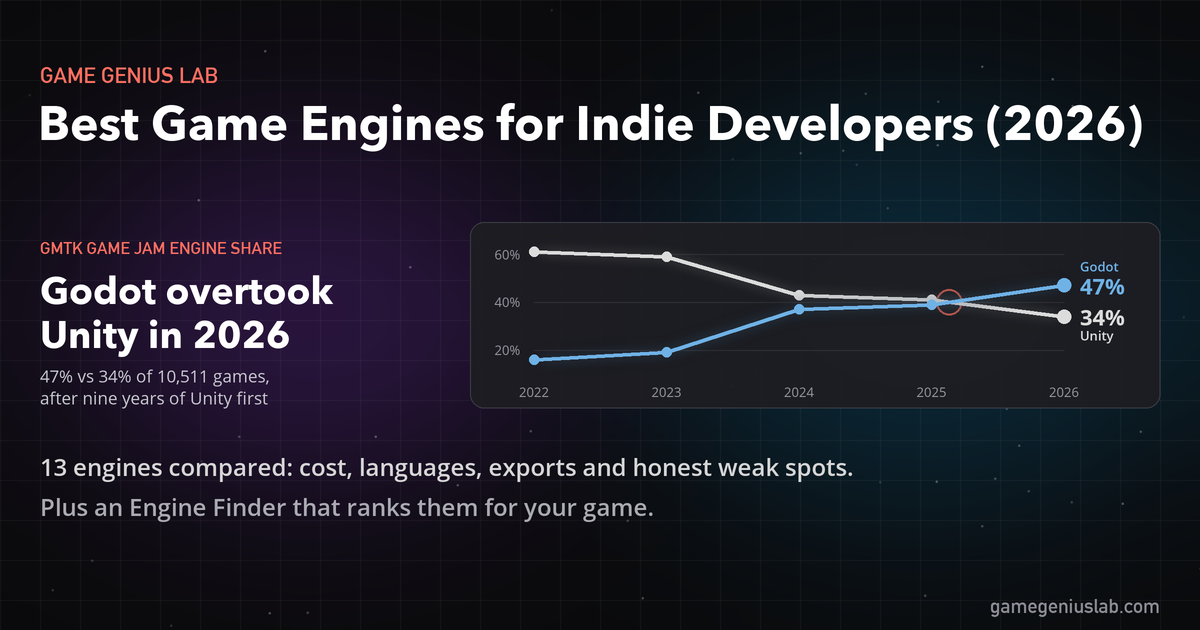
Godot, Unity, Unreal, GameMaker and nine more engines compared for 2026: what each costs, what it's best at, where it ships, and the weak spot fans skip. Includes a quiz that ranks them for your game.
This Post Has 0 Comments