



Jump, coin, hit, laser and explosion: five classic retro sound effects, built step by step in Pulse, our free browser sound effect generator. Play each one before and after in the Retro SFX Lab, learn why it works, and take the settings with you.
Steam Next Fest October 2026: What the Data Says About 7,300 Demos
Steam Next Fest October 2026
Where Would Your Demo Rank?
All 7,310 demos, ranked by the most players each one had at the same time (checked every hour for the whole week). Type a number or drag the slider.
#1rank of 7,310
top 1%of all demos
0demos behind it
Data: Output Lag's hourly player counts from Steam's public API; ranking and bands are Game Genius Lab's analysis. Peak players is not the same as unique players or wishlists, and idle games count players who leave them running. Output Lag checked once an hour, so a true peak from Steamworks may rank a little higher here than an hourly check would have caught.
Steam Next Fest October 2026 was the biggest one yet: more than 7,300 free demos in one week, about 67% more than in June. However, it was also the hardest one to stand out in. Most demos that recorded any players (59%) never had more than three people playing at the same time. By the last day, half of everyone still playing a Next Fest demo was in one of just ten of them.
I wanted to know what actually worked. So I went through the published numbers from Valve, GameDiscoverCo and How To Market A Game, ran my own analysis on Output Lag’s player data for every demo (it checked each one once an hour), and looked up the winners’ Steam followers. This post covers who won, which genres found players, how many demos disclosed AI, what it means if you build games with procedural generation, and how to get ready for February 2027. The rank checker above shows where any demo lands among all 7,310.
What is Steam Next Fest? Steam Next Fest is a free, week-long Steam event where players try demos of upcoming PC games and wishlist the ones they like. Valve runs it three times a year, in February, June and October, and each game can take part only once.
The Short Version
demos, up 67% from June
0
median new followers per demo
0
of demos that hit 100 players were co-op, 9% of the field
0
%
of demos disclosed generative AI
0
%
- Why so many: GameDiscoverCo expected about 5,000. It thinks most of the extra came from small games built largely with AI tools.
- Winners came in hot: the top 25 entered with a median of 5,519 followers. Everyone else had 15.
- Players aren’t fans: Worst Class Ever topped Valve’s most-played list, yet had the fewest Steam followers of the top ten.
- Engines split two ways: Godot rose to 17.4% of demos and “no engine detected” to 17.7%, yet Unity and Unreal made 81% of the top 100.
- Next up: February 22 to March 1, 2027. Registration closes January 10.
The Biggest Next Fest Ever
GameDiscoverCo counted 7,319 demos, up 67% from June, and thinks small AI-built games filled most of the jump.
GameDiscoverCo’s count of 7,319 demos matches Output Lag’s tally of 7,310. Over 8,000 were queued in Valve’s developer preview, but some studios pulled out before launch. Meanwhile, Valve itself only promised “thousands”.
That is about seven and a half times as many demos in three years, and Next Fest is growing faster than Steam itself. Steam’s releases are climbing too: GameDiscoverCo reports 2,875 new games in September 2026, 76% more than a year earlier. Even so, How To Market A Game estimates that the three 2026 editions held about 15,000 demos, more than half of the 29,000 or so games projected to release on Steam this year.
Why Were There So Many Demos?
GameDiscoverCo’s follow-up on October 30 gives the best explanation so far. Based on its trend line, it expected a little over 5,000 demos. The extra 2,000-plus look like “a filling-out of small, vibe-coded games”, meaning games built mostly by prompting AI tools. Simon Carless is clear that the evidence is suggestive, not proof:
- “No engine detected” jumped. That share sat near 12% to 13% for over a year, then reached 17.7%. Developers in GameDiscoverCo’s community say many vibe-coded games use web frameworks like Three.js, which its scanner can’t identify.
- Godot jumped too. It’s open source and has an MCP server that AI coding tools can drive, which makes it a popular base for AI-assisted builds.
- The least-played demos cluster in a few genres. Among “no engine detected” demos that peaked at a single player, GameDiscoverCo found mostly 2D bullet heaven, bullet hell and puzzle games.
In other words, AI tools didn’t flood every genre equally. They lowered the bar most for a few kinds of small games, and those lanes got the most crowded.
More Demos, Less Attention for Each One
Attention didn’t grow with the demo count. The median demo gained 5 followers, down from 18 a year earlier.
Player attention doesn’t grow seven and a half times when the demo count does, so each demo gets a thinner slice. A game at the top-10% mark gained 63 followers, against 173 a year earlier, and the median top-10 game added about 80,000 wishlists, against 143,000 in June.
Here’s the whole ladder, so you can see where your own demo would have landed. The follower gains are GameDiscoverCo’s. Next to them is my count of the most players at once at the same rank, from Output Lag, which checked every demo’s player count once an hour for the whole week, through Steam’s public API.
| Where a demo ranked | Followers gained during the fest | Most players at once |
|---|---|---|
| Top 1% | 740 | 437 |
| Top 5% | 148 | 60 |
| Top 10% | 63 | 19 |
| Top 25% | 17 | 6 |
| Median | 5 | 2 |
| Bottom 25% mark | 2 | 1 |
Both columns rank all demos; 768 never registered a single player.
How to Read These Numbers
Peak players is the most people in a demo at the same moment, checked once an hour. It’s the only number available for every demo, but it isn’t how many people tried one. For big demos whose developers posted totals, the peak was only about 1% to 5% of everyone who played. Long play sessions and idle games that run in the background push it up.
It isn’t wishlists either. For 14 top demos whose developers shared wishlist counts, Steam followers put them in almost the same order as their wishlists, and peak players didn’t come close. So this post compares genres by how many of their demos broke out, rather than adding up peaks, and shows followers wherever I have them.
At the close, ten demos held half of everyone still playing.
At that same moment, only 1,944 of the 7,310 demos (27%) had anyone playing at all. Next Fest still works, but mostly for games that bring an audience with them: How To Market A Game found that the top 25 demos entered with a median of 5,519 followers, against 15 for everyone else.
When Demos Had Their Best Hour
The hour each demo peaked tells a story of its own. For the first two days, Steam shows demos at random, and most small demos had their best hour then. After that, Valve’s personalized recommendations take over, and the demos that broke out usually peaked later. Half of the demos that reached 10 players had their best hour on Friday or later, and as many peaked on Saturday as on opening day. So if you’re planning posts, streams or updates for fest week, don’t spend them all on day one.
Who Won Steam Next Fest October 2026
Most winners arrived with an audience and played well with friends, and the biggest crowds didn’t always turn into fans.
There’s no single scoreboard. For example, Valve published a Top 50 of the most-played demos, ranked by unique players over the week. Output Lag ranks by peak concurrent players. GameDiscoverCo estimates wishlist gains from follower counts. As a result, the lists overlap, but not perfectly, so I’ve added each game’s Steam followers, the closest public signal to wishlists.
| Demo | What it is | Valve Top 50 | Most players at once | Steam followers |
|---|---|---|---|---|
| Worst Class Ever | Asymmetric school party game, 1 to 6 players | #1 (~600,000 players) | 27,684 | 1,978 |
| Probably Stolen | Cyberpunk shopkeeper sim | #2 | 39,696 (highest) | 37,269 |
| Find The Needle | Incremental haystack search | #3 | 9,711 | 8,675 |
| Fart Together | Physics co-op party game | #4 | 4,405 | 2,176 |
| ArcheAge Chronicles | Action MMORPG (Unreal Engine 5) | #5 | 19,855 | 67,390 (most) |
| Frostrail | Survival crafting on an armored train | #6 | 8,834 | 41,423 |
| just volleyball | Arcade volleyball, up to 6v6 | #7 | 9,598 | 6,792 |
| Character House | Idle desktop companion | #8 | 17,489 | 9,268 |
| Abyssal Lapidary | Gothic gem-cutting sim | #9 | 4,766 | 7,308 |
| Loftia | Cozy multiplayer life sim | #10 | 7,427 | 28,627 |
Valve Top 50 ranks as published by GameGrin and Gaming Age. GameDiscoverCo’s copy of the same list leaves out Frostrail, which moves the games below it up one place. Most players at once come from Output Lag. Followers are each game’s Steam community followers on November 1, after the fest; Probably Stolen had launched by then.
The last two columns tell different stories. Worst Class Ever drew the biggest crowd by Valve’s count but has the fewest followers in the top ten: a party game can pull in big groups of friends without building a following. Games with an existing fanbase, like ArcheAge Chronicles, Frostrail and Loftia, bring fans who don’t all show up at once. Outside the top ten, Stronghold 4 peaked at just 899 players but has almost 42,000 followers.
GameDiscoverCo also estimated wishlist gains during the week. Probably Stolen led with about 161,000, ahead of Abyssal Lapidary (121,000), ArcheAge Chronicles (93,000) and Emberville (79,000).
What the Winners Had in Common
Three things stand out:
- Most winners had an audience before the fest. Dreadmoor had 400,000 wishlists in September, Emberville 280,000 in February and Character House 200,000 before the fest started, all by the developers’ own counts. Similarly, Probably Stolen, Find The Needle and Character House were already the top three on GameDiscoverCo’s pre-fest demo chart.
- Several winners launched within days. Probably Stolen launched two days after the fest closed, to Overwhelmingly Positive reviews. By its own count it sold 350,000 copies in the first 24 hours and peaked at over 112,000 players at once, nearly three times its demo peak. Queen’s Domain, from a two-person team, went from 200,000 to 275,000 wishlists during fest week and launched on October 30. Loftia, Dreadmoor, ArcheAge Chronicles and several others go into Early Access in November. Across all demos, though, a launch date in the month after the fest made only a modest difference: those demos were a quarter of the field and a third of the top 100.
- Nothing won outright. Instead of one big genre trend, GameDiscoverCo saw only small trends spread across 10 to 15 subgenres: co-op “friendslop”, incremental games, shop and crafting sims, desktop companions, cozy builders and Lovecraftian horror.
Not a hype originator for most games, so much as a hype amplifier. GameDiscoverCo
Also, idle and desktop-companion demos keep counting players while they run in the background, so treat their peak numbers with care. Output Lag flags 1,038 of them, including 3 of the top 10 by peak players. They’re included in the rank checker and the genre numbers.
Which Genres Broke Out: An Analysis of 6,542 Demos
Co-op demos were about twice as likely as average to reach 10 players at once. Roguelikes were a bit less likely.
Output Lag sorts demos into 14 overlapping genre buckets and shows each demo’s top three Steam tags. Adding up each genre’s peak players doesn’t work well, because one hit can carry a whole genre. So I counted how many of each genre’s demos broke out: reached 10 players at once, or 100. Every demo counts once, however big it got.
Three patterns jump out:
- Playing with friends was the strongest hook. 36% of co-op demos reached 10 players at once, about twice the fest average of 18.5% (of demos that recorded players), and a quarter of the 256 demos that reached 100 were co-op. That also fits the top of the charts: Worst Class Ever, Fart Together, just volleyball and Mortuus are all built for groups. Co-op breakouts leaned on the weekend, when friends can play together: 41 of the 64 that reached 100 peaked on a Saturday or Sunday.
- Survival and sandbox games broke out more often. Among individual tags, Open World Survival Craft demos reached 10+ players 58% of the time, though there were only 24 of them. Colony Sim (34%), Automation (31%) and Sandbox (29%) also beat the fest average. Roguelite (13%), Action Roguelike (14%) and 2D Platformer (7%) fell below it.
- Story-rich games did worse than they looked. Added up, their peaks seemed about even with their share of demos, but Probably Stolen alone made up 71% of that total. Counted one demo at a time, only 15% of story-rich demos reached 10 players.
Of course, these are still peak players, not wishlists or sales, and the buckets overlap. Long play sessions and idle games that run in the background also help on this measure, which flatters survival, colony and automation games a little.
What It Means If You Build with Procedural Generation
Procedural generation worked as the engine under a hook, not as the pitch.
This is the part that matters most to readers here. Roguelikes were one of the most crowded lanes in the fest: 1,528 of the 6,542 demos with players, nearly one in four. The median roguelike demo peaked at 2 players, and only 15% reached 10. Steam Page Analyzer counts 1,505 Action Roguelike releases in 2026 by late September, up 57% on the same weeks of 2025. And among the least-played “no engine detected” demos, which GameDiscoverCo suspects are often vibe-coded, most were 2D bullet heavens, bullet hells and puzzle games. Bullet heavens sit right next to the roguelike lane, though as a group they did about average: 20% reached 10 players.
Even so, procedural generation itself did fine. It just wasn’t the pitch.
The Procgen Demos That Broke Out
The procgen demos that broke out put the generator underneath a social or systemic hook:
- Mortuus (Hamuno) is a round-based co-op zombie shooter that builds a new procedurally generated map every run. Rooms, corridors, doors, perk machines and the mystery box all move between runs. It was #10 or #11 on Valve’s Top 50, depending on the copy, and #7 in GameDiscoverCo’s wishlist estimates, with about 61,000 new wishlists.
- Dungeonbound (louidev, made in Godot) runs a Daily mode where every player gets the same rooms from one shared seed, plus three modifiers drawn each morning. It peaked at 1,518 players and, according to the developer’s own posts, went from 10,000 to 20,000 wishlists during the fest.
- Arctic Drive promises a procedurally generated Arctic that’s different every run, as a co-op road trip. Its developers built their own generator to work in multiplayer. It made Valve’s Top 50.
Only 38 demos had Procedural Generation among their top three Steam tags, and 9 of them (24%) reached 10 players, a little better than average. So the tag didn’t hurt. The breakouts, though, sold what the player does first (zombies, co-op, a daily climb), with procgen as the reason each run is different.
Players buy the hook. Procedural generation is how you keep it fresh.
Technique Patterns Worth Borrowing
A few technique patterns showed up in this fest’s procgen demos:
- Fixed grammar, shuffled layout. Mortuus always has doors, perk machines and a mystery box. Only where they sit changes. As a result, players learn the vocabulary once and still can’t memorize the map. Our cellular automata cave tutorial and the Brogue and Noita breakdown show the same idea at the level of single tiles.
- Seeded dailies. A deterministic seed is what lets Dungeonbound give everyone the same dungeon each day, which turns a solo run into something players compare and share. Every lab in our Poisson disk sampling tutorial uses a seed for exactly this reason.
- Authored landmarks in generated filler. Arcostate puts procedural zones inside a handcrafted overworld. Sand Cruiser regenerated its desert mid-fest so a wreck with two survivors always sits near the start. After all, a guaranteed point of interest early on helps a 30-minute demo make sense. Our biome generation tutorial and the Voronoi tutorial cover placing regions and landmarks on purpose.
- Variety isn’t choice. One developer found that new generation rules made content feel like it grew without limit, while upgrade picks stopped feeling like decisions. In short, procedural variety doesn’t replace meaningful choices.
About a Third of Demos Disclosed AI. Few Winners Did.
34.4% of demos disclosed generative AI, but only 2 of the top 25 did.
GameDiscoverCo counted 2,517 demos (34.4%) carrying Steam’s AI content disclosure, up from 26.5% in June and 21.2% in February. Chris Zukowski at How To Market A Game counted separately and got almost the same answer, 34.6%.
However, disclosure fell as popularity rose. Among the 25 demos with the most players at once, only 2 disclosed AI (8%), according to Zukowski.
Most of the disclosures cover supporting work. GameDiscoverCo sorted them by type: 69.8% mention visual art (often icons rather than all of it), 28.4% translation and 26.2% marketing. Only 1% generate AI content live while you play. Since January 2026, Steam asks developers to disclose AI-generated content that ships in the game or is generated live. AI tools used only to work faster, like code assistants, don’t need a disclosure.
Clone Fears and Valve’s Response
The fest also brought out fears of AI-assisted cloning. Alliance Arts cancelled the public demo of Drunken Goddess Reflux, Digital Sun scaled back a public playtest of ReVamp, and YNOT, a two-person Korean studio, pulled the public demo of Spookitchen, all citing fast copycats. The developers of Dragon’s Chronicles: Twin Stars of Reginleiv even reported an email demanding $200 under threat of an AI clone. The #3 demo, Find The Needle, is a different game built on a viral idea from August, and Zukowski calls it a clone that overtook the original.
Valve responded on October 27 that it won’t police which tools developers use. It also said that much of the criticism was based on the first two days, when demos are shown at random before personalized recommendations take over. Valve’s Tom Giardino added that extortion is a matter for the police, though Valve will follow up on reported cases, and that community trust and regular updates are a studio’s best defense against clones.
GameDiscoverCo reached a similar verdict from the data. Most AI-made games, it argues, won’t trouble the charts or compete with yours. The real competition is still skilled solo developers and tiny teams, who may use AI code help “like a scalpel”.
Procedural generation is not generative AI.
A seeded cave generator or a Poisson disk scatter is an algorithm you wrote. Because its output is predictable from its inputs, it needs no Steam disclosure. Several procgen demos in this fest also disclosed generative AI for art or music, which is a separate choice.
What Engines Were the Demos Built With?
Godot surged to 17.4% of demos, but Unity and Unreal made 81% of the top 100.
GameDiscoverCo scanned almost every demo. Unity still led with 45.9%, but “no engine detected” climbed to second at 17.7%, Godot reached 17.4% and Unreal fell to 12.3%.
So the picture splits in two. Across the whole fest, Godot is growing fast: it was 9.2% in February and 7.1% of Steam’s 2025 releases. Some of that is developers genuinely switching, and some probably comes from vibe-coded projects, since Godot is a popular base for AI-assisted builds. Among the demos players actually found, though, Unity and Unreal made 81% of the top 100. Dungeonbound is one of the Godot games that broke through, and ArcheAge Chronicles runs on Unreal Engine 5. For the full comparison of costs, languages and weak spots, see our guide to the best game engines for indie developers.
What Next Fest Actually Does for Your Wishlists
What you bring decides what you get: pre-fest wishlists and recent momentum predict fest results best.
The best public benchmarks come from How To Market A Game’s developer surveys. However, they over-represent developers who market actively, so read them as “what a prepared game gets”, not as the typical result.
| Wishlists the day before the fest | Median wishlists earned during the fest | Middle 40% of games |
|---|---|---|
| 0 to 999 | 322 | 179 to 485 |
| 1,000 to 9,999 | 1,006 | 549 to 1,722 |
| 10,000 to 99,999 | 5,215 | 2,584 to 9,633 |
| 100,000+ | 12,882 | 9,989 to 27,661 |
February 2026 survey, 174 games.
- What you bring matters most. Pre-fest wishlists were the strongest predictor of fest wishlists (a rank correlation of 0.825).
- Momentum matters about as much. In June 2026, 82% of games with more than 2,000 wishlists and more than 2,000 new ones in the previous two weeks earned 3,000+ during the fest. Only 6% of games low on both did.
- Most players won’t wishlist, and that’s normal. The median demo turned 16% to 19% of its players into wishlists.
- The real median is lower. GameDiscoverCo’s dashboard put the median October demo at about 60 new wishlists during the fest week, alongside the 5 new followers above.
What’s a wishlist worth? For games launching with more than 25,000 wishlists, GameDiscoverCo’s median is first-week sales of about 0.15 times launch wishlists, or 0.10 times for games priced over $10. Still, nobody has measured whether fest wishlists convert worse than others, though Zukowski suspects they do.
Wishlist Reality Check
Enter your numbers to see what games like yours earned in recent fests. These are survey benchmarks from developers who market actively, not a prediction.
Wishlists earned during the fest
Odds of a strong fest (3,000+ wishlists)
What that could mean at launch
Sources: How To Market A Game's February 2026 benchmarks (174 games) and June 2026 momentum study (119 games); GameDiscoverCo's wishlist conversion medians. October's fest was 67% bigger than June's, and GameDiscoverCo estimates the median October demo gained only about 60 wishlists all week, so treat these as what a prepared game gets.
How to Prepare for Steam Next Fest February 2027
Registration closes January 10, 2027. Build your audience and momentum before the fest, not during it.
| Date (Pacific) | Milestone |
|---|---|
| December 8, 2026 | Valve’s live developer Q&A |
| January 10, 2027 | Registration deadline |
| January 18 | Demo and store page in for review, if you want to be live for the press preview |
| February 1 | Everything submitted for review |
| February 11 | Press preview starts |
| February 22 to March 1 | The fest |
Because a game gets one Next Fest, ever, the real question is whether February is your fest. Here’s what the data supports, and where it’s only opinion:
- Measured: build your base and momentum first. Followers and recent wishlist growth predicted fest results better than anything else the surveys measured.
- Measured in players: groups and systems broke out more often. Co-op demos were about twice as likely as average to reach 10 players at once, and survival crafting, colony sims and automation beat the average too. If your game has a co-op mode or a systemic hook, put it in the demo and the capsule.
- Pattern, not proof: lead with the fantasy and the activity. The procgen breakouts sold co-op zombies and a daily climb, not the generator. Let the generator be the reason the second run is different.
- Mixed: release the demo early. Games with older demos did better in February’s survey, but October’s top 25 had demos live for 19 days on average, against 37 for everyone else. A sample of our own points the same way: the top 50 demos by peak players had been out a median of about a week. A demo that sits unseen for months doesn’t help on its own.
- Opinion: enter the last fest before launch. That’s How To Market A Game’s advice, and many of October’s winners launched within weeks. Valve’s own guidance is that there’s no right answer.
- Opinion: don’t hold back on outreach. Valve sends the press list about 10 days before the fest, and breakout stories often credit creators and press. There’s no controlled data either way.
Steam Next Fest FAQ
How many demos were in Steam Next Fest October 2026?
GameDiscoverCo counted 7,319, up 67% from June. Output Lag counted 7,310 and How To Market A Game counted 7,240 a few days in. Valve didn’t publish an official count.
Why were there so many demos in October 2026?
GameDiscoverCo expected a little over 5,000. It thinks most of the extra came from small games built largely with AI tools, pointing to jumps in “no engine detected” and Godot demos and to a cluster of tiny bullet heaven, bullet hell and puzzle games.
When is the next Steam Next Fest?
February 22 to March 1, 2027, starting and ending at 10 a.m. Pacific. Registration closes January 10, 2027. The edition after that runs June 14 to 21, 2027.
Can a game be in Steam Next Fest more than once?
No. Valve’s rule is that a game may appear in Next Fest only once. Prologues and short versions of games already on Steam aren’t eligible either.
Is peak player count a good way to judge a Next Fest demo?
Only partly. Peak players is the most people in a demo at the same moment, so it rewards long play sessions and idle games, and for the big demos it was only about 1% to 5% of everyone who played. Steam followers track wishlists much more closely, so watch your follower gain alongside your peak.
How many wishlists do you get from Steam Next Fest?
It depends mostly on how many you bring. In How To Market A Game’s February 2026 survey, the median game with fewer than 1,000 wishlists earned 322 during the fest, and the median game with 10,000 to 99,999 earned 5,215.
Do you have to disclose AI in a Steam Next Fest demo?
Yes, if AI-generated content ships in the game or is generated while it runs. Since January 2026, AI tools used only for efficiency, like code assistants, don’t need a disclosure. Procedurally generated content made by your own algorithms isn’t generative AI.
Final Thoughts
October’s Next Fest didn’t break. It got crowded. The games that won mostly arrived with an audience, gave players something to do with friends or a system to get lost in, and kept climbing into the final weekend. Meanwhile, everyone else split a crowd that didn’t grow nearly as fast as the demo count.
For anyone building with procedural generation, though, the lesson is encouraging. Generators were behind some of the fest’s best surprises. They just weren’t the headline. Sell the hook, and let the generator keep it fresh.
Next steps:
- Pick an engine with our best game engines for indie developers guide.
- Make each run different, but readable: start with cellular automata caves or Poisson disk placement.
- Give the demo its own sound: how to make retro sound effects for your game, free in your browser.
Were you in this Next Fest, or are you aiming for February? Tell me how it went in the comments, numbers welcome.
All read October 28 to November 1, 2026: GameDiscoverCo’s October 2026 fest report and its follow-up on the demo surge, its June 2026 and February 2026 fest reports and its wishlist conversion study; How To Market A Game on October’s demos and AI disclosures, wishlist benchmarks and momentum; Output Lag’s player data, checked hourly (genre, distribution and timing figures are my own analysis of its public data); Steam follower counts from each game’s community page on November 1, compared with wishlist counts developers posted on Steam; GameGrin’s copy of Valve’s Top 50; Valve’s Next Fest, February 2027 and content survey pages; Valve’s response via Inven Global and heise; Inven Global on Spookitchen and the extortion emails; Steam Page Analyzer; and each game’s Steam page.
Related Posts
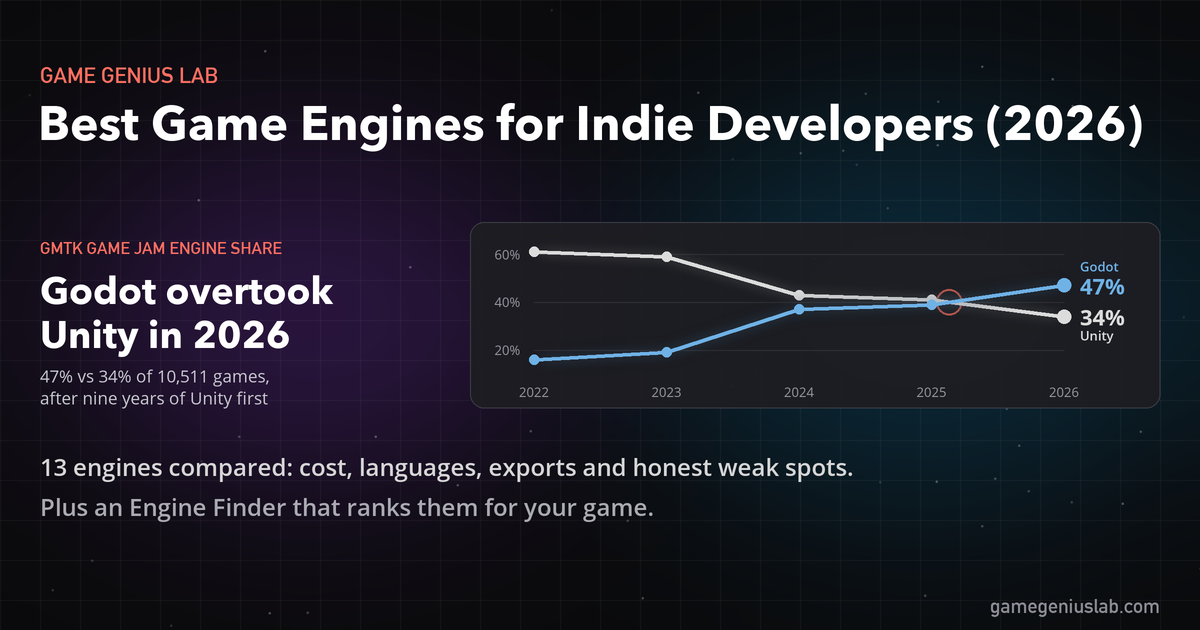
Godot, Unity, Unreal, GameMaker and nine more engines compared for 2026: what each costs, what it's best at, where it ships, and the weak spot fans skip. Includes a quiz that ranks them for your game.
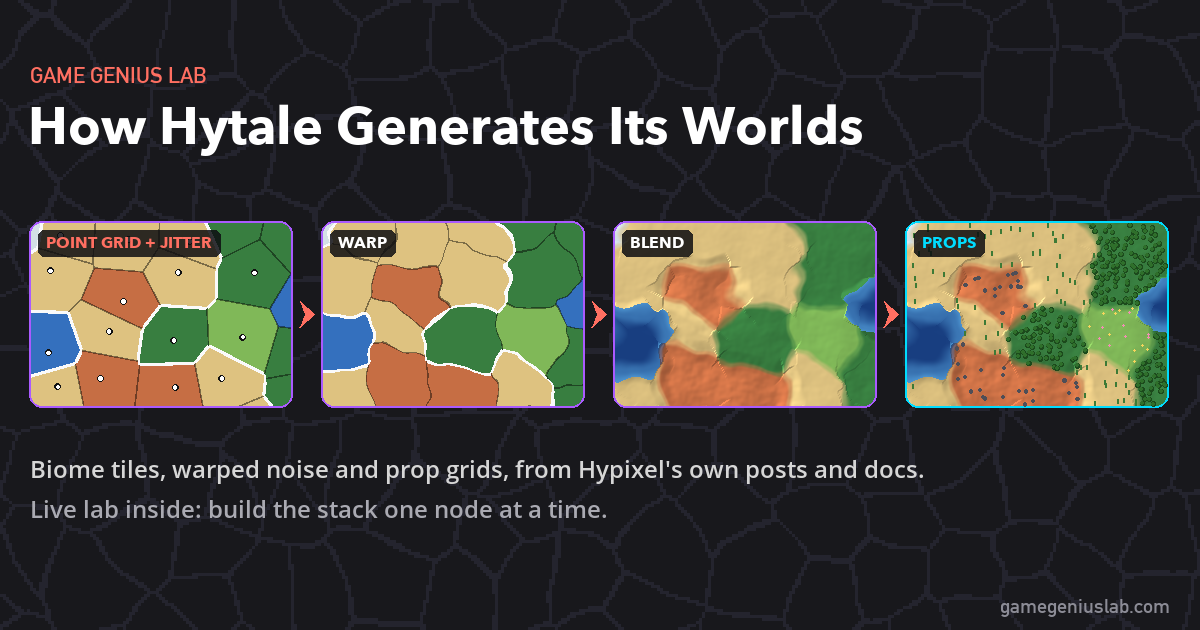
Hytale's next world generator treats every biome as a tile, blends the terrain across the seams and scatters props on a point grid. Here's what Hypixel has shared about World Gen V2, plus a live lab where you can build the same kind of stack.
This Post Has 0 Comments